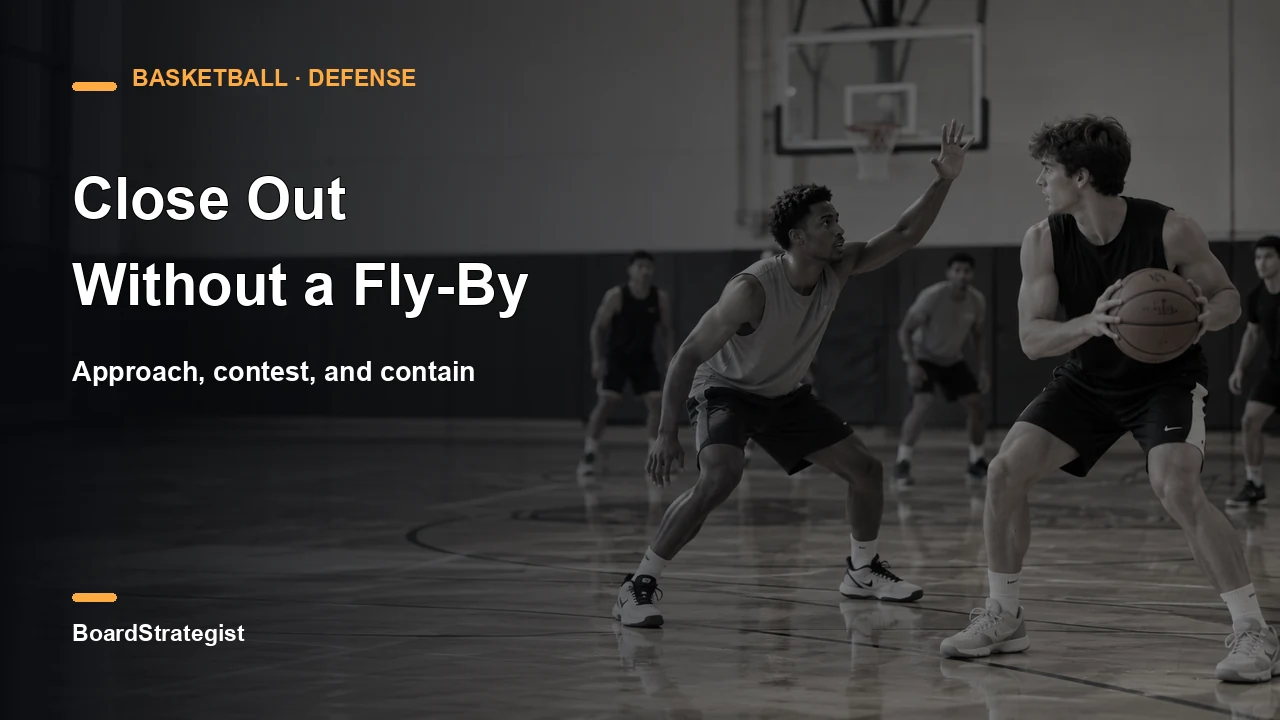
A closeout is a defender’s approach to a new ball handler after a pass, with the goal of pressuring a shot while staying ready to contain a drive. Sprinting all the way into the player can make the defender fly past; stopping too far away can give the shooter time and space.
This guide explains adaptable movement cues and practice ideas that begin with a 1-on-1 closeout. The angle and direction a defender tries to influence depend on the team’s help positions and shared rules. The drills below are editorial suggestions.
Close the distance, then slow down near the player
When the pass travels, the defender quickly covers ground toward the receiver. As they get close, they shorten their steps and stay balanced. Arriving at full speed can make it hard to react to a shot fake or drive and may carry the defender past the ball handler.
The FIBA/WABC coaches manual describes sprinting toward the receiver and using quick, small steps near the opponent to regain balance. It also distinguishes a longer closeout to reach a shooter from a shorter stop against a driver. Choose the approach to fit the opponent and the team’s defensive rule.
Contest the shot while keeping a stance for the drive
As the opponent catches the ball, the defender raises both hands to challenge the shot and help stay balanced. At the same time, the defender stays balanced and ready to move laterally if the player starts a dribble. Reaching forward and leaning off balance, or bringing the feet together to stop, can delay the next movement.
- Within shooting range: Raise a hand to pressure the shot and avoid running into the shooter’s landing space.
- The player starts a dribble: Move with the feet and take away the team’s agreed direction.
- A teammate must help: See the ball and your matchup, then communicate the help and next rotation.
Whether to influence a drive toward the right, middle, or baseline is not universal. Coaches should align that choice with the team’s help position so players share the same reference.
Avoid the fly-by and finish the defensive possession
If a defender jumps at a shot fake, the offense may drive or draw contact. Practice responding to a fake without leaving the floor, while seeing the ball and the player’s balance. Avoid swinging the arms down or moving into the shooter’s landing space.
The defense must continue after the initial closeout. Maintain your matchup after a pass while adjusting your position to the ball and the help location. Switches and rotations follow the team’s agreement and communication. Join the rebound when a shot goes up. Observing help and recovery along with the closeout shows whether the team defended the whole possession.
Start with a pass, then add a 1-on-1 and help
- Pass and approach: Pass to a wing player. The defender runs toward the receiver, shortens the steps near the player, and checks the final stance and hand position.
- 1-on-1 after the catch: The offense may shoot, fake, or drive. The defender pressures the shot without flying by and moves their feet to contain the drive.
- 2-on-2 with help: Add one offensive player and one defender to practice help on the drive and recovery after a pass. Follow the team’s agreed influence direction.
- Short live possessions: Start with a pass and observe whether the defense continues through help, recovery, and the rebound.
Review one cue at a time: Did the defender slow down near the player? Did they contest the shot? Could they stay down on a fake and move with the drive? Focused feedback gives players a clear adjustment to try.
Frequently asked questions
Should a defender always raise both hands?
The FIBA/WABC manual describes raising both hands at the end of a closeout; follow your team’s coaching approach for hand and foot position. Avoid lunging or unsafe contact.
Which way should the defense force the drive?
That depends on the team’s help position and the opponent. Agree on the direction together with the location of help, then practice the same reference.
What is a good first closeout drill?
Begin with a pass and a controlled approach to check balance. Then let the receiver choose a shot, fake, or drive in 1-on-1, and add a helper in 2-on-2.
Takeaway
A closeout covers ground quickly, then uses shorter steps to arrive balanced. Pressure the shot with a raised hand while staying ready to move with the drive, and agree on the team’s help direction.