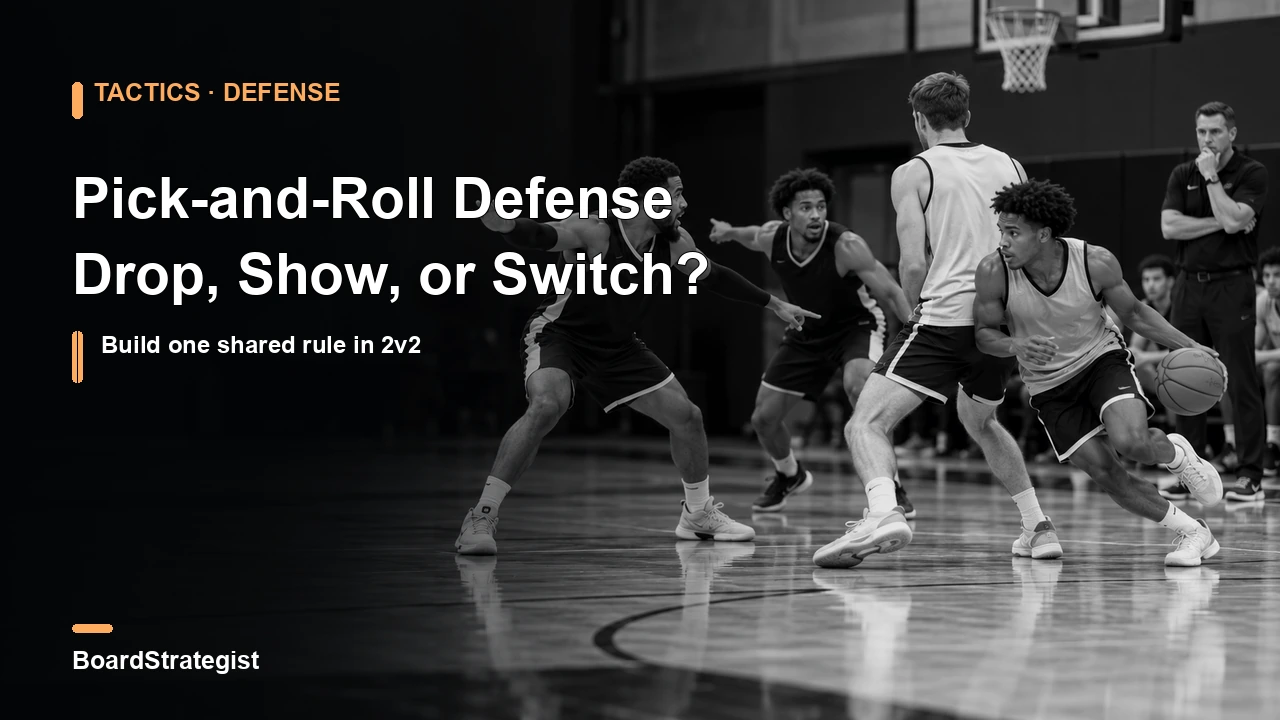
When an offense uses a pick-and-roll, the on-ball defender and the screener’s defender need a shared plan. Drop, show, and switch are common options, but none is automatically best for every team or situation.
Coaches choose a coverage based on the players, team priorities, and where the screen happens. This guide defines the terms briefly and shows how to practice a shared rule in 2v2. These summaries are for orientation; they do not replace a team’s detailed defensive instructions. The drill sequence is an editorial proposal, not a summary or recreation of the linked videos.
Start with one agreement both defenders understand
Before the screen arrives, the on-ball defender and the screener’s defender need the same call. The team may adjust the call based on the screen location, the handler’s shooting and driving, and what the screener does next.
- Drop: The defender guarding the screener stays closer to the basket to protect against a drive and roll. Both defenders coordinate their distance and help position.
- Show: The screener’s defender steps out briefly toward the ball handler, then recovers to their matchup while the on-ball defender gets back into position.
- Switch: The two defenders exchange matchups around the screen. They must then recognize any mismatch and how teammates will help.
Teams use different words and systems, including flat, ice, or traps. Do not react to a label alone: make sure players know the movement and team call that go with it.
Separate tactical choices from JBA competition criteria
Drop or show describes a team’s tactical coverage; it is separate from any defensive standard a competition may adopt. For competitions whose regulations specify the JBA Man-to-Man Defense Criteria, check that document. The June 24, 2026 edition allows defenders to exchange matchups after a screen, help defense, or trap, but does not allow switching with the purpose of continuing to defend an area.
The criteria do not recommend traps for U12 players. They do allow trapping the player in control of the ball at any time for both U12 and U15. Treat this as age and competition context, not a universal tactical instruction. The JBA U12 Coaching Guidelines, second edition (2021), are developmental guidance and should be read separately from competition rules.
Choose based on whom you are guarding and what you want to stop
The handler’s shooting, the screener’s roll or pop, the defenders’ speed and size, and the screen’s location can all matter. Near the basket, the defense may prioritize the drive and roll. Farther out, the handler’s shot may be a larger concern.
Those examples do not produce an automatic answer. Consider the opponent, fatigue, and help positions, then choose a team rule players can execute together. If the plan adds a trap or extra rotation, teach how the defense recovers before adding it to live play.
The first two defenders are not the whole possession
After the initial coverage, the ball may move to the roller or another teammate. Weak-side defenders need to see the ball and their matchup, decide when to help, and recover to a pass. When a shot goes up, finish the possession with a rebound.
In practice, observe more than whether the handler was stopped. Track the pass to the screener, the next rotation, and the box out. If a teammate is open after the first coverage, the defensive possession is not over.
Practice from a slow 2v2 to 3v3
- Slow 2v2: Use two offensive players and two defenders (four players total). Move through the screen slowly to check the positions and call; defenders focus on positioning and communication rather than forcing a turnover.
- 2v2 with one rule: The offense uses the screen; the defense practices one agreed coverage. Pause to align the call and recovery positions.
- 2v2 with reads: Let the offense choose a roll, pop, or drive so defenders must recognize what comes next.
- 3v3: Add a teammate and continue through help, the next pass, and the rebound.
If the defense breaks down, check whether both players understood the same rule and whether the rule fits the situation before blaming an individual player.
Frequently asked questions
Which is best: drop, show, or switch?
There is no single best choice for every team. Consider the opponent and defenders, where the screen occurs, and which rule the team has practiced.
What if a switch creates a mismatch?
Follow the team’s agreed help or exchange plan. The two defenders who switched should not be the only players communicating; teammates also need to know whom they are guarding.
How should a team begin practicing coverage?
Begin with all four players in a slow 2v2 to check positions and calls, then use one agreed coverage in 2v2. Add more offensive choices and a third teammate as the defense becomes consistent.
Takeaway
Pick-and-roll defense starts with two defenders sharing one rule and continues through help, recovery, and the rebound. Choose drop, show, or switch to fit the players and situation, then rehearse the call and recovery in 2v2.
Sources
- NBA Coaches Association, Coaches Corner: Defending the Pick-and-Roll
- FIBA / WABC Coaching Clinic Videos
- Japan Basketball Association, Man-to-Man Defense Criteria (June 24, 2026)
- Japan Basketball Association, U12 Coaching Guidelines, 2nd edition (2021; developmental guidance)