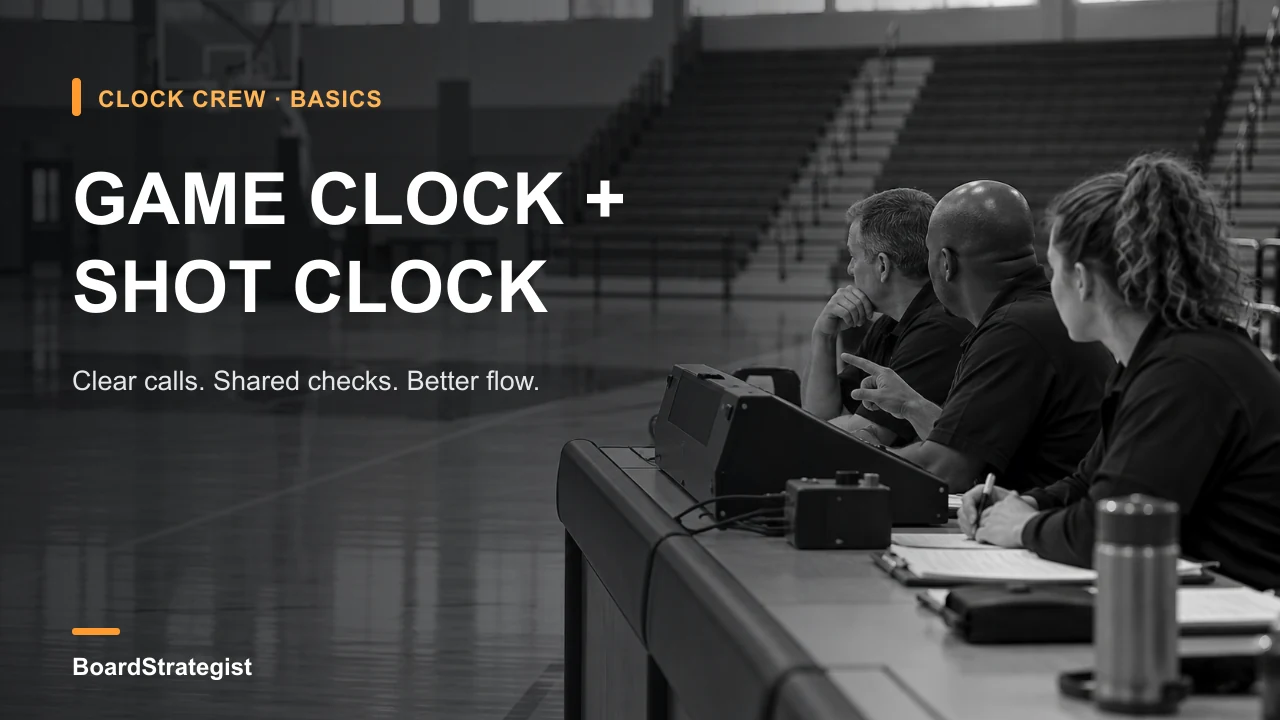
The game clock and shot clock may be operated by different people. The essential habit is to call out each action and visually verify the other display, not just your own controls. This guide summarizes the workflow and age-group timing shown in the Japan Basketball Association’s 2026 U12 and U15/U18 table-official handbooks. It is not a shortcut for deciding a reset or restart independently.
Agree on roles and calls before the game
Confirm who is operating the game clock and who is operating the shot clock (SC). Check the controls, displays, buzzer location, and how you will communicate if sound is hard to hear. Share equipment quirks and event-specific procedures during the crew briefing.
JBA’s handbooks describe the operators calling “start” or “stop,” then checking that the other clock actually moved before replying “OK.” The clocks generally move together, but there are different start moments in some situations, including the opening jump ball. Check the current manual for the category you are assigned to.
U12, U15, and U18 have different game and timeout lengths
The JBA 2026 table-official handbooks list the following basic timings by age group. Follow the rules adopted by your competition and any event-specific instructions.
| Category | Quarter | Overtime | Timeout |
|---|---|---|---|
| U12 | 6 minutes | 3 minutes | 45 seconds (signals at 35 and 45 seconds) |
| U15 | 8 minutes | 3 minutes | 60 seconds (signals at 50 and 60 seconds) |
| U18 | 10 minutes | 5 minutes | 60 seconds (signals at 50 and 60 seconds) |
These are standard timings listed in JBA’s table-official manuals for reference. The competition’s adopted rules, organizer’s special regulations, and event briefing take priority. Before play, confirm the start and remaining-time calls so timeout timing is not confused with other clock operations.
When the whistle sounds, stop before checking the instruction
At the whistle, coordinate the call and stop both clocks. Do not reset the shot clock first. Check the referee’s report or instruction, then confirm whether the shot clock resets or continues with the remaining time. If you are unsure, ask the referee or follow the event’s procedure rather than guessing.
A short sequence helps: whistle → stop → check the report or instruction → call the setting → partner verifies the display. The U12 and U15/U18 JBA handbooks include communication examples after fouls and violations.
Prepare for an inbound restart
Before play resumes, check substitutions or timeouts, the game-clock display, and the shot-clock setting. Under the game-clock start/stop tables in the JBA 2026 U12 manual (p. 6) and U15/U18 manual (p. 7), when the game clock is stopped, restart it when a player on the court legally touches the inbound pass; coordinate the call and operation.
If the clock is already running after a made goal, do not stop or restart it just for the inbound. After made goals, the clock generally continues in U12. In U15/U18, it continues except during the last 2:00 of the fourth quarter and each overtime. A made goal in that window stops the game clock; restart it when a player on the court legally touches the inbound pass. Follow the competition’s adopted rules and event instructions if they differ.
The correct shot-clock reset or continuation depends on the play and current rules. Do not infer it from the inbound location alone; check the referee’s report or instruction. For the rule mechanics, see our 8-second and 24-second guide.
Watch the display after a shot or rebound
Whether the ball touched the ring and which team controls it can affect the shot-clock operation. Check both your own control and the partner’s display. If a display does not match what the crew expects, notify the referee and table supervisor rather than making an undocumented correction.
A pregame checklist
- Confirm the timer and SC operator, controls, displays, and buzzer
- Check the competition’s current rules and age-group TO manual
- Agree on start/stop calls and the “OK” response
- After a whistle, stop first and check the referee’s report
- Before a restart, verify both displays together
- Know whom to contact about equipment or uncertain operations
Sources
- JBA table-official manuals and downloads (2026 edition)
- JBA 2026 U12 Table-Official Manual Handbook
- JBA 2026 U15/U18 Table-Official Manual Handbook
The handbooks are procedural guides for table officials. Referees make rulings; follow the competition’s adopted rules, regulations, and current category manual.
Related articles
8-second and 24-second rule mechanics · Table-official roles and scorer checklist