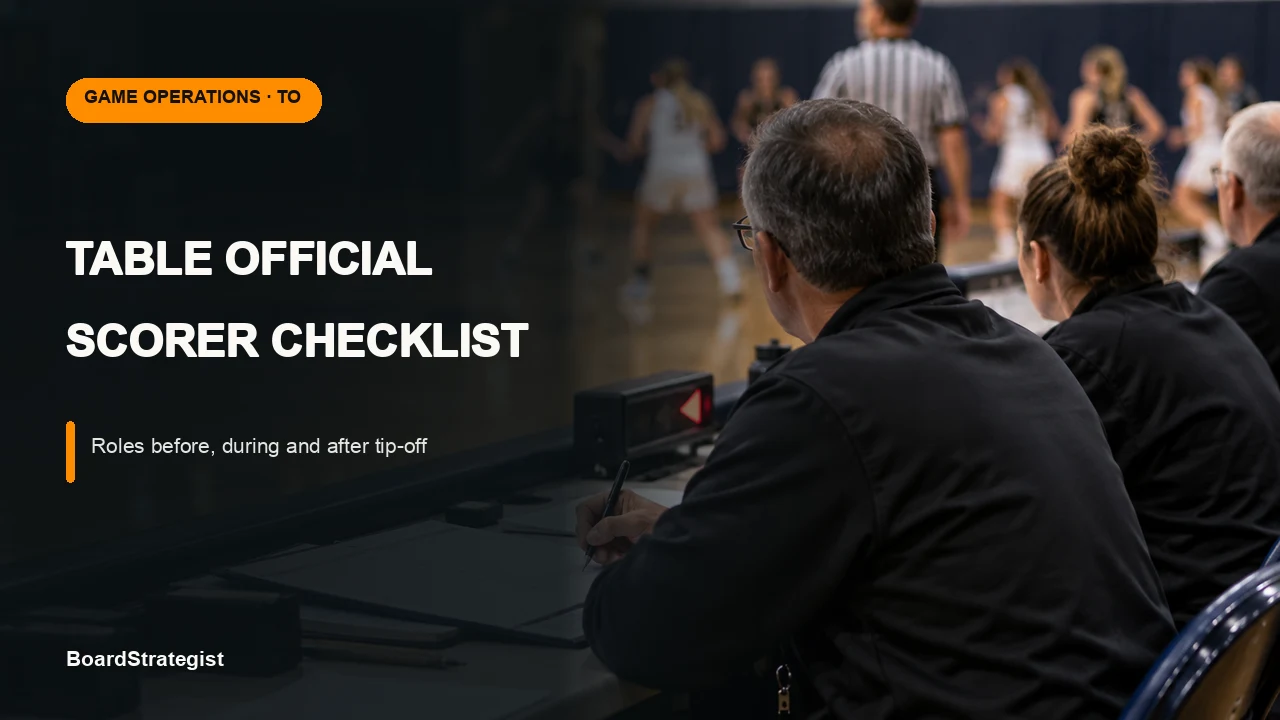
Table officials do more than record points
Table officials (TOs) support a game by keeping records, operating clocks and displays, and communicating with referees. The Japan Basketball Association’s 2026 simplified TO manual describes four core roles: scorer, assistant scorer, timer, and shot-clock operator. For U12 and U15 games, it allows an additional person when duties are appropriately divided.
Each person has a defined task. If something does not match, the crew follows the applicable rules. Use the tournament regulations and briefing for actual crew size and procedures.
The four core roles
| Role | Main responsibility |
|---|---|
| Scorer | Maintains the scoresheet, gives referees required signals such as time-out or substitution notices, and operates the possession arrow. |
| Assistant scorer | Operates the scoreboard and foul displays and assists the scorer. |
| Timer | Operates the game clock and tracks intervals and time-outs as assigned. |
| Shot-clock operator | Operates the shot clock. |
Before tip-off, confirm who operates each display and how the crew will communicate questions or discrepancies.
Before the game: prepare the record and equipment
- Review the event briefing for applicable rules, role assignments, signals, and equipment.
- Complete the required scoresheet fields, such as competition, date, venue, and game number.
- Check team names, player numbers, and starters using the event process.
- Confirm the scoreboard, clocks, foul displays, possession arrow, and buzzer are ready.
- Set up the table and ask the TO lead or organizer about anything unclear.
The exact scoresheet process and starter checks depend on the competition; one event’s local procedure is not universal.
During the game: coordinate records and displays
The scorer records points and fouls and communicates required information to referees. The assistant scorer supports the displays. If the display and record appear to differ, do not independently change them. Check the applicable rules and use the prescribed communication process.
- After a score, confirm that both record and display were updated.
- Confirm that foul and time-out information reached the assigned operator.
- When the clock starts or stops, check the signal and ball status, and acknowledge the action with the relevant crew member.
- If an error appears, do not make a ruling on your own. Notify the referee at the time required by the rules.
The JBA’s 2026 manual describes table officials as neutral, like referees. Their job is accurate recordkeeping and game operations, not deciding what happened in a play.
After the game
Complete the event’s record confirmation, signatures, and equipment return steps. Rules can limit when a scoresheet error may be corrected; the process can change after officials sign. Do not make an independent amendment. Promptly tell the referee or event organizer.
A first-assignment checklist
- Your role and the adjacent official’s role
- Which fields and equipment must be checked before the game
- How to communicate substitutions, time-outs, fouls, and discrepancies
- Who to notify, and when, if a record may be wrong
- The event’s local procedures and the person to ask for help
Frequently asked questions
Are the scorer and assistant scorer the same role? No. The JBA’s 2026 manual assigns scoresheet and referee-signal duties to the scorer, and scoreboard and foul-display support to the assistant scorer.
Can a first-time volunteer work alone? That depends on the competition. Ask the organizer whether orientation or experienced support is available, and follow current rules and event instructions.
What if the scoreboard and scoresheet disagree? Do not edit the record independently. Raise it with the referee or event lead; the correct handling depends on the situation and whether the scoresheet has been signed.