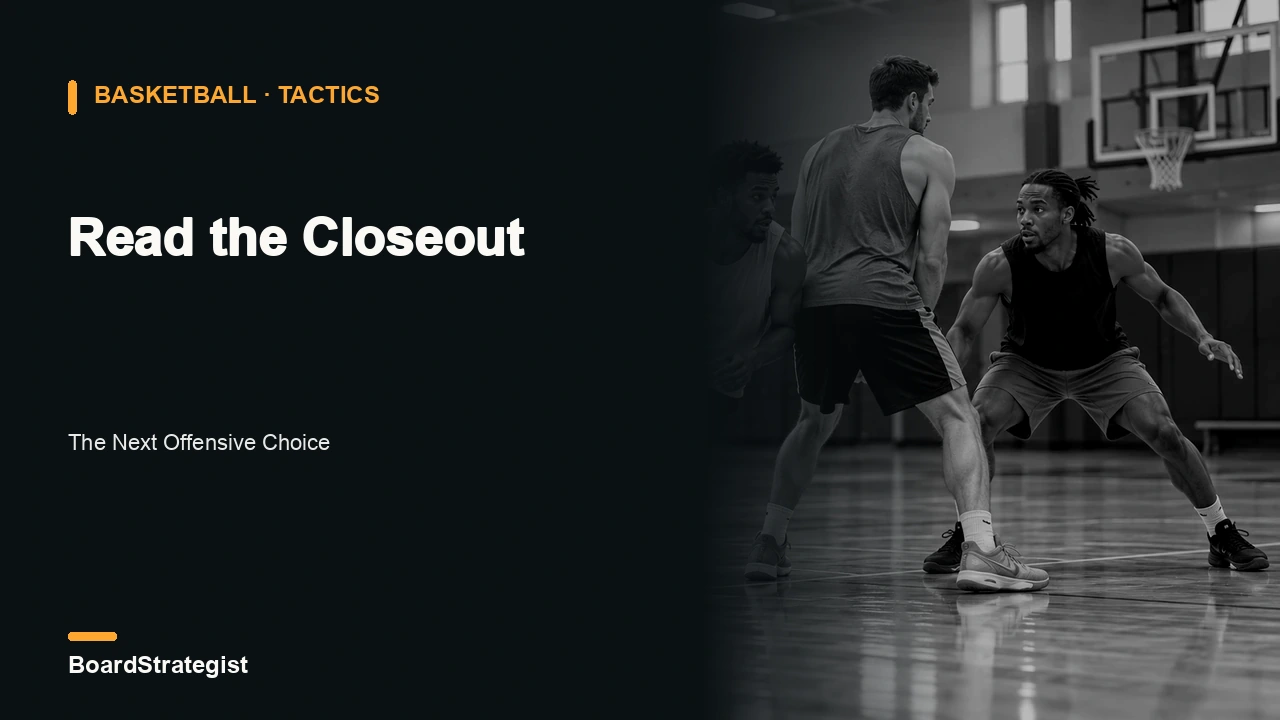
A player receiving a pass while a defender closes out faces a familiar decision. “Always shoot” or “always drive” can make the player ignore the defender's position and momentum. Practice should help players notice a cue and choose a response, not simply memorize a fixed answer.
Read the defender first
Before the catch, scan the rim, teammates, and defender. As the ball arrives, notice the defender's distance, speed, approach angle, and balance. These are clues for a decision, not a rule where one cue automatically dictates the answer.
- If the defender is still at a distance and balanced, a prepared shot may be available.
- If the defender rushes forward, a drive into open space or a pass after drawing help may be options.
- If the defender takes away one direction, check the open space and help position before attacking.
Team principles, a player's strengths, time, and score can all matter. These are possible reads, not universal prescriptions.
Build the read from a one-on-one drill
Start on the wing. Pass to the attacker while the defender varies the closeout direction or speed on a coach's cue. Ask the attacker to notice their scan before the catch, readiness on the catch, and first step. Begin with a shot-or-drive choice; add a stop or kick-out only when players can explain the initial read.
After each repetition, ask what the player saw. A made shot alone does not prove that the decision was good, and a miss alone does not prove it was poor. Review decision and execution separately.
Add help defense
Add one help defender and observe where the drive is contained and which passing lane appears. Instead of requiring a pass to a fixed spot, ask players to find the space created when help moves. Adjust the numbers and space so each player gets chances to read and act.
Ask a short reflection question
- What did you scan before the catch?
- Which part of the closeout influenced your choice?
- Where did you look when help moved?
FIBA/WABC coach education resources can provide broader context for designing learning activities. These examples are adaptable coaching ideas, not official rules. Adjust them for player age, experience, and a safe practice environment.
Sources
Frequently asked questions
Does every closeout call for a shot or a drive?
No. Read the defender together with team principles, teammate spacing, and game context. The responses here are examples, not fixed answers.
How is this different from a defensive closeout drill?
This article focuses on the offensive player's choice after receiving the ball. It does not teach the defender's footwork or shot-contest technique.
Is the same drill right for every age or level?
Not necessarily. Adjust spacing, numbers, and defensive intensity for the group, and follow the team's safety guidance.