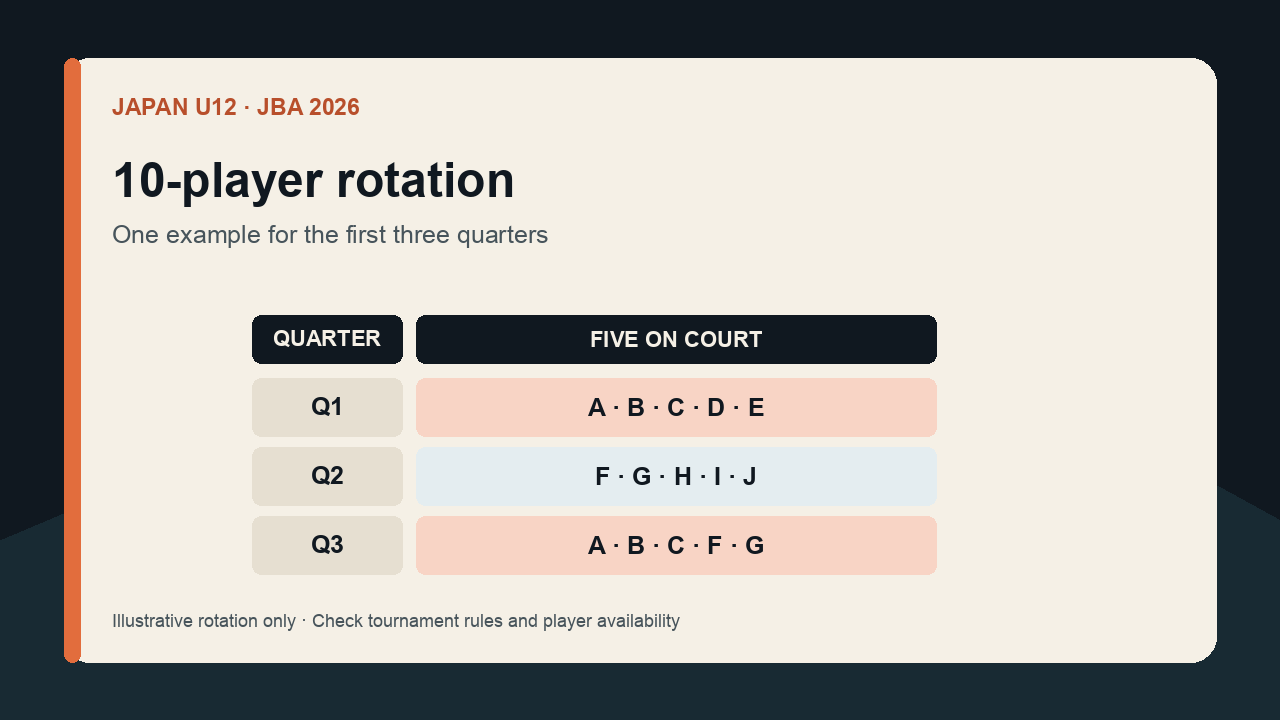
Planning the first three quarters for a 10-player mini-basketball team is easier when the coach can see each five-player group at a glance. This article gives one example under the Japan Basketball Association’s 2026 mini-basketball rules, along with a short checklist for adapting it.
This is an example, not a required lineup or a promise of equal playing time. It applies to the Japanese JBA rule context described below. Tournament regulations and the players available on game day take priority.
The JBA requirements to check
Under the JBA’s 2026 Mini-Basketball Rules (Japanese PDF), a team registered with 10 or more players must have at least 10 players each appear for at least one quarter, but no more than two quarters, by the end of Q3 (Rule 4-2-1). Through Q3, a player may not play three consecutive quarters.
Q1–Q3 substitutions are allowed during playing intervals and halftime only (Rule 19-2-1), so a quarter-by-quarter lineup is useful for pregame planning. The JBA rules also allow domestic tournament organizers to change some team-composition conditions. Read the current event regulations before relying on this example. Injuries, fouls, disqualifications, and other game situations may also require a change.
One Q1–Q3 plan for 10 players
| Quarter | Five players on court | Appearances by end of quarter |
|---|---|---|
| Q1 | A, B, C, D, E | A–E: 1 |
| Q2 | F, G, H, I, J | F–J: 1 |
| Q3 | A, B, C, F, G | A, B, C, F, G: 2; D, E, H, I, J: 1 |
At the end of Q3, all 10 players have appeared at least once, nobody has played more than twice, and no player has appeared in three consecutive quarters. The example makes the Q3 group the main coaching choice instead of repeating either earlier five-player group unchanged.
Three checks when you build a rotation
1. Verify the participation conditions first
Put player names down the side and Q1–Q3 across the top. Mark each planned appearance, then count them: everyone at least once, each player no more than twice, and no three-quarter run. Absences or an in-game injury can make the original plan impossible, so follow the tournament’s instructions and officials’ direction if the situation changes.
2. Rotate the second appearance across games
In this example A, B, C, F, and G appear twice. There is no need to use the same five players in every game. In a multi-game event, track who played twice in the previous game and consider a different Q3 group next time. Include each player’s condition, preferences, and the roles the team is working on in practice.
3. Plan Q4 separately
This table covers only the first three quarters. Decide Q4 based on the game, fouls, fatigue, each player’s condition, and the team’s approach. Satisfying the Q1–Q3 conditions does not determine Q4 minutes or guarantee equal total playing time.
Explain the rule separately from the coaching choice
When you share the rotation, distinguish the rule requirements from the reason for choosing this particular group. The Japanese-language parent guide for watching a mini-basketball game offers a family-facing companion.
If you review game actions, you can look at your rotation notes alongside a scorebook. See the Japanese-language basketball scoring guide for scorekeeping basics. This does not mean the scorebook automatically tracks playing time.
Takeaway
For a Japanese team registered with 10 players, a written Q1–Q3 plan makes it easier to check appearances and consecutive quarters against the JBA 2026 rules. Use the table as a starting point, read the tournament regulations, and adjust for the players’ real conditions on game day.
Source: JBA 2026 Mini-Basketball Rules (Japanese PDF), effective April 1, 2026; Rules 4-2-1 and 19-2-1.