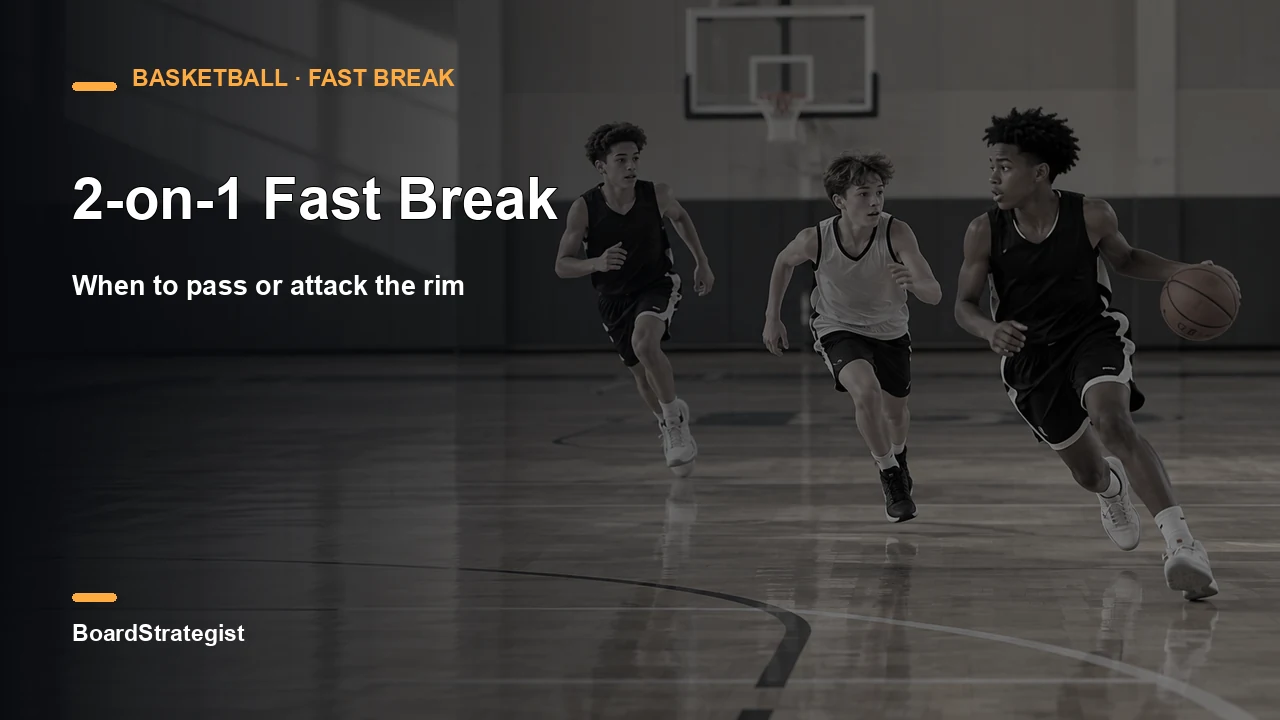
In a 2-on-1 fast break, the ball handler has to decide whether to attack or pass to a teammate. Instead of choosing before the play begins, both players can read whom the lone defender is trying to stop and use the available advantage.
This guide covers lane spacing, the ball handler’s visual cues, and a gradual practice progression. It draws on FIBA/WABC coaching material. The practice ideas below are editorial suggestions, not an official curriculum.
Use spacing so both players can see the defender
The ball handler can advance near the middle while the teammate runs in a separate lane. When both players crowd the same space, one defender can cover them more easily. The teammate should keep moving ahead and stay where the ball handler can see them.
Agree on lanes and a simple cue for attacking the basket. Adjust the spacing to the court and players’ speed so the two attackers can keep their options open.
If the defender commits to the ball, look for the teammate
The ball handler watches whether the defender moves into the ball’s path or protects the teammate’s lane. If the defender commits to the ball and a passing window opens, pass to a spot where the teammate can receive the ball in stride. Lead the receiver into open space rather than throwing to a stationary target.
If the defender moves toward the teammate and leaves the ball handler’s route open, attack the rim. Keep dribbling while reading the defender; do not stop just to decide whether a pass might be available.
- Defender steps toward the ball: Check whether the teammate is free for a pass.
- Defender steps toward the teammate: Attack the space the ball handler can reach.
- Defender stays between both attackers: Keep the spacing, protect the dribble, and continue reading rather than forcing a pass.
These are cues, not automatic rules. A defender may change direction, so the two attackers should keep communicating through their eyes and voices.
Pass to a spot where the teammate can keep moving
A pass that arrives too early or too close to the defender can take away the receiver’s momentum or invite a steal. Consider the defender’s position, the receiver’s running path, and the distance to the basket. Aim for a catch that lets the teammate continue into a layup or shot.
After passing, the original ball handler should keep moving toward the basket and stay available for a return pass or rebound if the defender recovers.
Build from a stationary 2-on-1 to a live read
- Check the spacing: Start with two attackers and one defender. Walk through the lanes and identify what defender movement would open a pass or a drive.
- Move the defender: The defender chooses whether to protect the ball or the teammate. Attackers identify the defender’s position before choosing.
- Play live 2-on-1: Vary the ball-handler’s starting point and the defender’s position. Review the reason for the decision, not only whether the shot went in.
- Add a recovering defender: Once the reads are consistent, add a defender trailing the play so players must make the same decision under more realistic pressure.
Evaluate whether the ball handler saw the defender, whether the teammate maintained spacing, and whether each player finished the chosen action. A made basket is only one part of the decision.
Frequently asked questions
Should the ball handler always pass in a 2-on-1?
No. If the defender commits to the ball, a pass may open up; if the defender protects the teammate, the ball handler may have a driving lane. Read the defender.
Where should the teammate run?
Use a lane separate from the ball handler and remain visible. Set a team agreement that fits your court and players.
How many players do we need to start?
Three players can begin with two attackers and one defender. Rotate roles, then add a trailing defender when the basic read is clear.
Takeaway
In a 2-on-1, the ball handler reads the defender while the teammate keeps useful spacing. Start from a clear, slow setup, add defensive freedom gradually, and review the decision behind the play as well as the result.
Sources
- FIBA / WABC Coaches Course Manuals
- FIBA / WABC Level 1 Coaches Course Manual (section 2.3.4 covers the 2-on-1 fast break)